
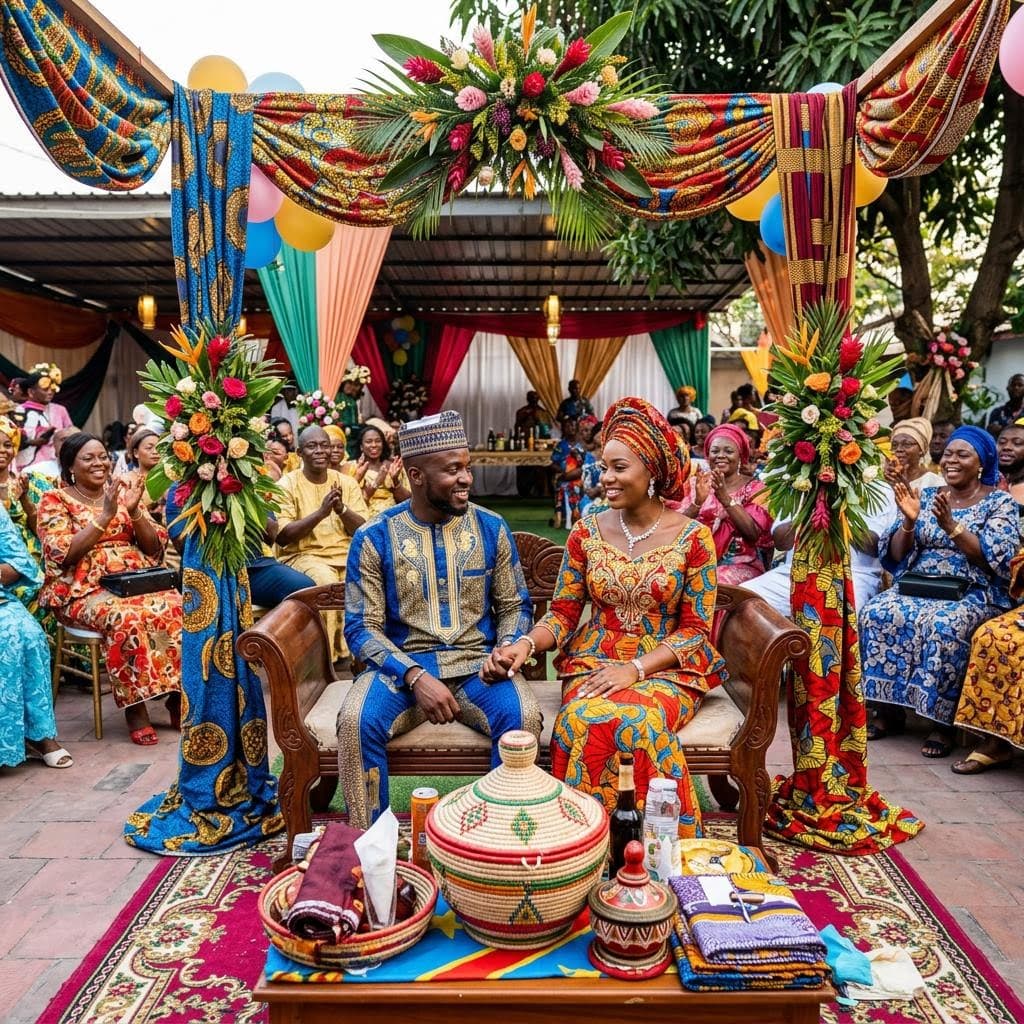
Congolese wedding: dowry traditions, outfits and order of events
A Congolese wedding is a family celebration that can include a customary ceremony, a civil marriage, a religious service and a large reception.
The expression "Congolese wedding" can refer to traditions from République démocratique du Congo or République du Congo. Customs also vary by region, community and family.
The engaged couple must therefore prepare each step with their relatives in order to respect the traditions that actually concern them. For an overview of continental traditions, see our guide to the African wedding ; also discover our articles dedicated to the Senegalese wedding and the Ivorian wedding.
The first meeting of the families
Before the main ceremony, the two families can organize an initial meeting. It allows the prospective groom or bride to be officially presented and announces the plan for union.
Depending on family practices, this meeting can be accompanied by:
- a letter of request ;
- a symbolic gift ;
- drinks ;
- fabrics ;
- a meal ;
- the presence of family representatives.
Relatives can use this moment to set a new date and explain the steps to follow.
The official request
In some families, the official request is presented by representatives of the groom's family.
The spokespersons can explain the couple's intentions and hand over an initial present to the future bride's family.
This step can be very solemn or include humorous exchanges between the families.
The engaged couple must know the program and be able to clearly express their consent and wishes.
The Congolese dowry ceremony
The dowry ceremony occupies an important place in many Congolese families. It marks the official coming together of the two families and can precede the civil or religious ceremonies.
The content and meaning of the dowry vary according to family traditions. It may include:
- fabrics ;
- clothing ;
- jewelry ;
- drinks ;
- foodstuffs ;
- symbolic objects ;
- a mutually determined contribution between the families.
The dowry should not be presented as the price of a person. In the families that practice it, it represents a stage in the alliance between the relatives of the prospective spouses.
How to prepare the dowry list?
The list must be sent early enough to allow for the search and purchase of the various items.
The couple and their representatives must check:
- the meaning of each gift ;
- the quantities ;
- the people to whom the gifts are intended ;
- the mode of presentation ;
- the transport ;
- the necessary budget.
It is not advisable to use a generic list found on the Internet, because requests can be very different from one family to another.
One person should be in charge of checking the items before leaving for the ceremony venue.
The déroulement of the customary ceremony
The program can include:
- The arrival of the groom's family.
- The welcome by the bride's family.
- The presentation of the representatives.
- The official request.
- The presentation of the gifts.
- The exchanges between the families.
- The presentation of the couple.
- Advice and blessings.
- The meal and the celebration.
A master of ceremonies or a relative can explain each step to guests who do not know the traditions. To prepare this step in detail, see our guide to the African customary wedding.
The role of the spokespersons
The spokespersons conduct the exchanges between the two families. They must know the customs, the names of the participants and the order of interventions.
Before the wedding, it is necessary to specify:
- who opens the ceremony ;
- who represents each family ;
- who presents the gifts ;
- who pronounces the blessings ;
- who thanks the guests ;
- how long each intervention may last.
Prior preparation makes it possible to maintain a warm atmosphere without excessively delaying the meal.
The bride's outfits
The bride can wear a traditional outfit, a wrapper set, a modern dress or a white gown.
She can plan several changes for the different stages:
- dowry ceremony ;
- civil marriage ;
- religious ceremony ;
- reception ;
- dance party.
The clothes can be made from a fabric chosen specially for the couple and decorated with embroidery, beads or matching accessories.
The bride must have a private space and a person in charge of helping her during the changes.
The groom's attire
The groom can wear a suit, a wrapper set, a boubou or a traditional outfit representing his family.
The couple can use the same fabric or choose complementary colors.
It is recommended to plan a comfortable outfit for the dancing part, especially when the reception is expected to last several hours.
Coordinated outfits for the families
Relatives can wear a fabric or color corresponding to their family.
This coordination helps create a strong visual identity and highlights group photos.
The couple must communicate in advance:
- the chosen fabric ;
- the colors ;
- the quantity available ;
- the possible price ;
- the deadline for tailoring ;
- the recommended accessories.
Each person should keep some freedom in choosing the cut.
Civil and religious marriage
The couple can complement the customary ceremony with a civil marriage or a religious ceremony according to their convictions.
The different stages can be organized on the same day, the same weekend or on several dates.
To choose the best solution, take into account:
- the budget ;
- the availability of relatives ;
- travel ;
- outfit changes ;
- the duration of the ceremonies ;
- the venue capacity.
When several events are grouped together, a precise schedule and a coordinator are necessary.
The meal at a Congolese wedding
The meal can bring together several specialties from RDC, République du Congo or the regions of origin of the two families.
The menu can notably include:
- pondu or saka-saka ;
- fumbwa ;
- liboke ;
- chikwangue ;
- rice ;
- plantains ;
- grilled meats ;
- fish dishes ;
- meat dishes ;
- various traditional sauces.
Since recipes may vary, the couple should organize a tasting with the caterer.
Vegetarian options must also be provided and information about allergies collected.
Buffet or plated service?
The buffet allows offering several specialties and letting guests compose their plate.
To avoid queues, several service points should be installed and table call organization set up.
Plated service offers a more formal experience but requires enough staff.
A mixed formula can include buffet starters and a main course served at the table.
Congolese music
Music is essential to create the atmosphere of the reception. The playlist can combine different generations of artists and several styles.
It can notably include:
- Congolese rumba ;
- ndombolo ;
- gospel music depending on the ceremony ;
- afrobeats ;
- traditional songs ;
- French and international tracks.
Congolese rumba represents a shared cultural element between the two Congos and their diasporas.
The DJ must know the important music for the families and prepare the tracks intended for entrances, outfit changes, the first dance and the cake.
Dances and entertainment
The dance floor generally occupies an important place during the reception.
The couple can plan:
- an orchestra ;
- percussionists ;
- a singer ;
- dancers ;
- a choreography by relatives ;
- a photobooth ;
- a video retracing the couple's story.
The entertainment must be coordinated with the meal and the speeches.
An overly packed program can reduce the time devoted to guests and to the celebration.
Decoration
The decoration can reuse the colors of the fabrics worn by the couple and the families.
It can include:
- elements in wrapper fabric ;
- flowers ;
- handmade objects ;
- baskets ;
- natural materials ;
- golden accessories ;
- a photo area ;
- a sign with the couple's first names.
It is advisable to concentrate the decoration on the entrance, the tables and the area reserved for the couple.
Organizing a Congolese wedding in France
Couples living in France can adapt traditions to the availability of relatives and the constraints of the venue.
They can notably:
- organize the dowry on a different date ;
- bring together several ceremonies during the same weekend ;
- involve relatives living in Congo by video ;
- prepare a program explaining the traditions ;
- plan a menu representing both families ;
- book accommodation for guests coming from far away.
The newlyweds must also check the venue hours to avoid overruns during speeches or entertainment.
Preparing the schedule
The program can include:
- The arrival of the guests.
- The welcome of the families.
- The customary ceremony.
- The presentation of the dowry.
- The speeches and blessings.
- The meal.
- Outfit changes.
- Entertainment.
- The first dance.
- The arrival of the cake.
The schedule must be sent to the spokespersons, the caterer, the DJ, the photographer and the videographer.
Finding vendors for a Congolese wedding
Professionals familiar with Congolese traditions, cuisine and music will be better able to anticipate the couple's needs.
On DreamWeds, you can search for venues, caterers, photographers, videographers, tailors, decorators, DJs and other professionals to organize your Congolese wedding.
Frequently asked questions about the Congolese wedding
Are the traditions identical in the two Congos?
No. They vary by country, region, community and family.
Is the dowry ceremony mandatory?
It depends on family traditions and the place where the union is celebrated. The couple should check with their relatives and the relevant authorities.
How many outfits should be planned?
There is no rule. The newlyweds can wear a single outfit or alternate between traditional clothes, a white dress and a suit.
What music should be chosen?
Congolese rumba, ndombolo, afrobeats and tracks chosen by the families can make up the playlist.
Can the dowry and the reception be organized on the same day?
Yes, provided the duration of interventions is limited and a precise schedule is prepared.
DreamWeds
Find your dream vendors
Photographers, caterers, venues and much more — compare up to 4 vendors side by side.
Find vendors for my weddingArticles on the same topic
Organizing a Multicultural Wedding: Practical Tips
Blending two traditions, addressing guests from different cultures, and creating a ceremony that is meaningful for both families.
African wedding menu: dish ideas and tips for choosing your caterer
Ceebu jën, yassa, attiéké, ndolé or jollof: discover our African menu ideas and our tips for choosing your wedding caterer.
African wedding attire: pagne, bazin, kente and tips for choosing
Pagne, bazin, kente or aso oke: discover how to choose the bride and groom's outfits and coordinate families for an African wedding.