
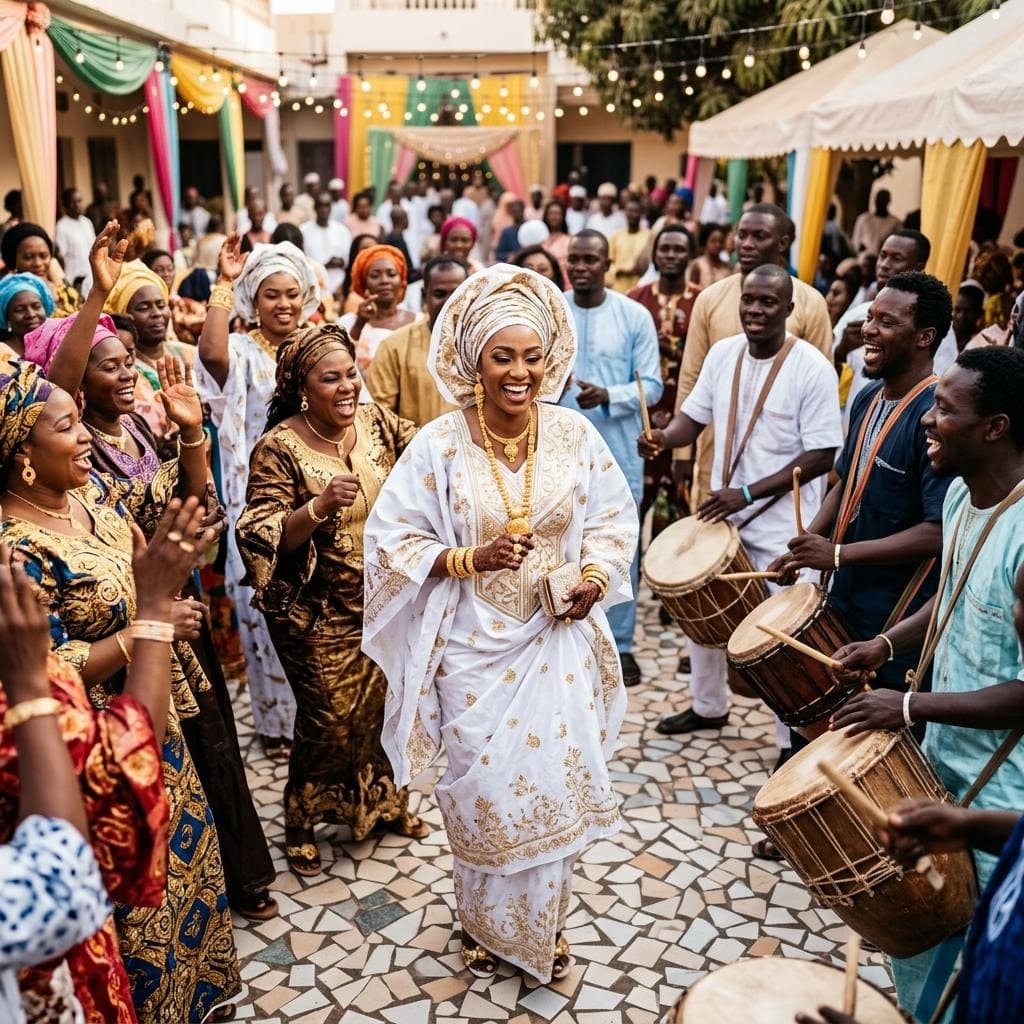
Senegalese wedding: traditions, outfits and the course of the ceremony
The Senegalese wedding is a family celebration marked by the elegance of the outfits, the generosity of the meal, the music and the presence of loved ones.
Traditions vary according to communities, regions, religions and families. A Wolof, Sérère, Fulani, Diola, Mandinka or Soninké wedding will not necessarily follow the same customs.
The future spouses can preserve the traditions important to their families while organizing a modern reception that matches their personality. For an overview of traditions across the continent, see our guide to African weddings.
The meeting of the families
Before the wedding, the two families may organize an official meeting. It allows the future spouses to be introduced and to discuss the plan for the union.
Depending on family habits, this meeting may include:
- speeches ;
- gifts ;
- fabrics ;
- drinks ;
- provisions ;
- a meal ;
- a blessing by the elders.
Relatives can also discuss the date, the number of guests and the schedule of the different ceremonies.
It is advisable for the future spouses to ask their parents which traditions must be preserved and which steps can be adapted.
The engagement and the official proposal
Some families organize an official proposal before the main ceremony. Representatives of the groom’s family may meet the bride’s family and present various gifts.
The composition of the presents varies according to communities and family habits. It can be defined during exchanges between relatives.
The future spouses must be informed of each step and remain at the center of decisions.
The traditional ceremony
The traditional ceremony can take place before the civil or religious ceremony. It officially brings the two families together and celebrates their new bond.
Its program may include:
- The arrival of the families.
- The presentation of the future spouses.
- Speeches by the representatives.
- The handing over of gifts.
- Advice from the elders.
- Blessings.
- The meal.
- Music and dances.
This schedule must be adapted to the real traditions of the families concerned. To prepare this step in detail, see our guide to the African customary wedding.
The religious ceremony
Depending on the couple’s beliefs, the wedding may include a Muslim, Christian or other spiritual celebration.
The religious ceremony can be organized on the same day as the reception or on a different date. Some families prefer an intimate moment, while others invite a large number of relatives.
The spouses should inquire directly with the chosen religious leader to know the preparations and any documents required.
The importance of family
Family often occupies an important place during the preparations and the course of the ceremony.
Parents, uncles, aunts and elders can participate in:
- welcoming guests ;
- presenting the families ;
- speeches ;
- blessings ;
- the handing over of gifts ;
- meal preparation ;
- coordinating traditions.
To avoid misunderstandings, each person must know their role before the wedding.
The couple can listen to the advice of relatives while retaining the final decision on how to organize their day.
Teranga and welcoming guests
Teranga is often associated with hospitality, sharing and attention to others. This value can be found in the welcoming of guests and the generosity of the meal.
The couple can plan:
- a welcome ensured by relatives ;
- drinks available upon arrival ;
- clear seating organization ;
- a sufficiently generous meal ;
- special attention to elderly guests ;
- thanks addressed to the families.
Good organization makes it possible to warmly receive guests without exhausting the spouses and their relatives.
The bride's outfits
The bride may wear several outfits during the different ceremonies. She may choose a white dress, a bazin outfit, a grand boubou, a lace ensemble or a creation made from another fabric.
Clothes can be decorated with embroidery, beads and matching accessories.
The choice of colors can be coordinated with the groom’s outfit, the wedding party or the decoration.
When several changes are planned, the bride should have a private space and a person assigned to help her.
The groom's outfit
The groom may wear a suit, a grand boubou or a traditional ensemble made especially for the ceremony.
He may alternate between a modern outfit and one that represents his origins.
The fabric, embroidery and colors can be matched to the bride without being completely identical.
A fitting with shoes and accessories is recommended before the wedding.
Coordinated outfits for the families
Families can choose a common color or fabric to create coordinated outfits.
The couple must provide early enough:
- the fabric reference ;
- the quantity available ;
- the possible price ;
- the deadline for tailoring ;
- the allowed colors ;
- the level of formality.
It is preferable to let each guest choose a cut adapted to their age, style and comfort.
The meal at a Senegalese wedding
The meal is one of the most important moments of the reception. The menu can bring together several specialties representing the families of the spouses.
It may notably include:
- ceebu jën or thiéboudiène ;
- poulet yassa ;
- mafé ;
- rice ;
- grilled meats ;
- pastels or fatayas ;
- salads ;
- fruits ;
- desserts.
Ceebu jën, a dish based on rice, fish and vegetables, holds an important place in Senegalese culinary heritage.
Since recipes can vary by region and family, a tasting should be organized with the caterer before the reception.
Drinks
The spouses can offer various traditional and modern drinks.
The buffet can include:
- bissap ;
- ginger juice ;
- bouye ;
- fruit juices ;
- water ;
- sodas ;
- coffee or tea.
Quantities should be adapted to the season, the number of guests and the duration of the reception.
A reserved area for drinks can facilitate service during the cocktail.
Music and dances
Music contributes strongly to the wedding atmosphere. It can combine Senegalese, African, French and international songs.
The program can include:
- mbalax ;
- sabar ;
- percussion ;
- afrobeats ;
- traditional songs ;
- tracks chosen by the families.
The couple can hire a DJ, percussionists, a singer or a band.
Entrance songs, outfit-change music, the first dance and the cake entrance should be chosen in advance.
Decoration
The decoration can echo the colors of the outfits or draw inspiration from Senegalese textiles and crafts.
It can include:
- fabrics ;
- baskets ;
- golden elements ;
- floral arrangements ;
- artisanal objects ;
- a photo area ;
- a sign bearing the couple’s first names.
It is preferable to choose a few coherent references rather than mix many patterns.
The couple’s area, the tables and the entrance of the venue should form a harmonious whole.
Organizing a Senegalese wedding in France
A wedding organized in France can preserve the main traditions while adapting to family availability and venue constraints.
The couple can notably:
- organize the family meeting at home ;
- combine the traditional ceremony and the reception ;
- involve relatives living in Senegal by video ;
- plan a menu representing both families ;
- prepare a bilingual program ;
- explain the traditions to guests.
When relatives come from afar, information about transport and accommodation must be communicated early enough.
Preparing the schedule
A detailed schedule must be communicated to the venue, the caterer, the DJ, the photographer and the family representatives.
It can include:
- The arrival of guests.
- Welcoming the families.
- The entrance of the spouses.
- Speeches and blessings.
- The meal.
- Outfit changes.
- Entertainment.
- The first dance.
- The arrival of the cake.
- The dance party.
One person should be in charge of coordinating transitions on the wedding day.
Finding vendors for a Senegalese wedding
Professionals familiar with Senegalese cuisine, music and traditions will better meet the couple’s expectations.
On DreamWeds, you can search for venues, caterers, photographers, videographers, tailors, decorators, DJ and other vendors to organize your Senegalese wedding.
Frequently asked questions about the Senegalese wedding
Do all families follow the same traditions ?
No. Practices vary according to communities, regions, religions and family habits.
How many outfits does the bride wear ?
There is no rule. She can wear a single outfit or alternate between traditional clothes and a white dress.
Which dish should be chosen for the reception ?
Ceebu jën, yassa or mafé can be offered, but the menu should reflect the preferences of both families.
Can all ceremonies be organized on the same day ?
Yes, provided a precise schedule is prepared and enough time is allowed for travel and outfit changes.
When should the caterer and DJ be booked ?
It is advisable to book them several months in advance, especially during the high season.
DreamWeds
Find your dream vendors
Photographers, caterers, venues and much more — compare up to 4 vendors side by side.
Find vendors for my weddingArticles on the same topic
Organizing a Multicultural Wedding: Practical Tips
Blending two traditions, addressing guests from different cultures, and creating a ceremony that is meaningful for both families.
African wedding menu: dish ideas and tips for choosing your caterer
Ceebu jën, yassa, attiéké, ndolé or jollof: discover our African menu ideas and our tips for choosing your wedding caterer.
African wedding attire: pagne, bazin, kente and tips for choosing
Pagne, bazin, kente or aso oke: discover how to choose the bride and groom's outfits and coordinate families for an African wedding.