
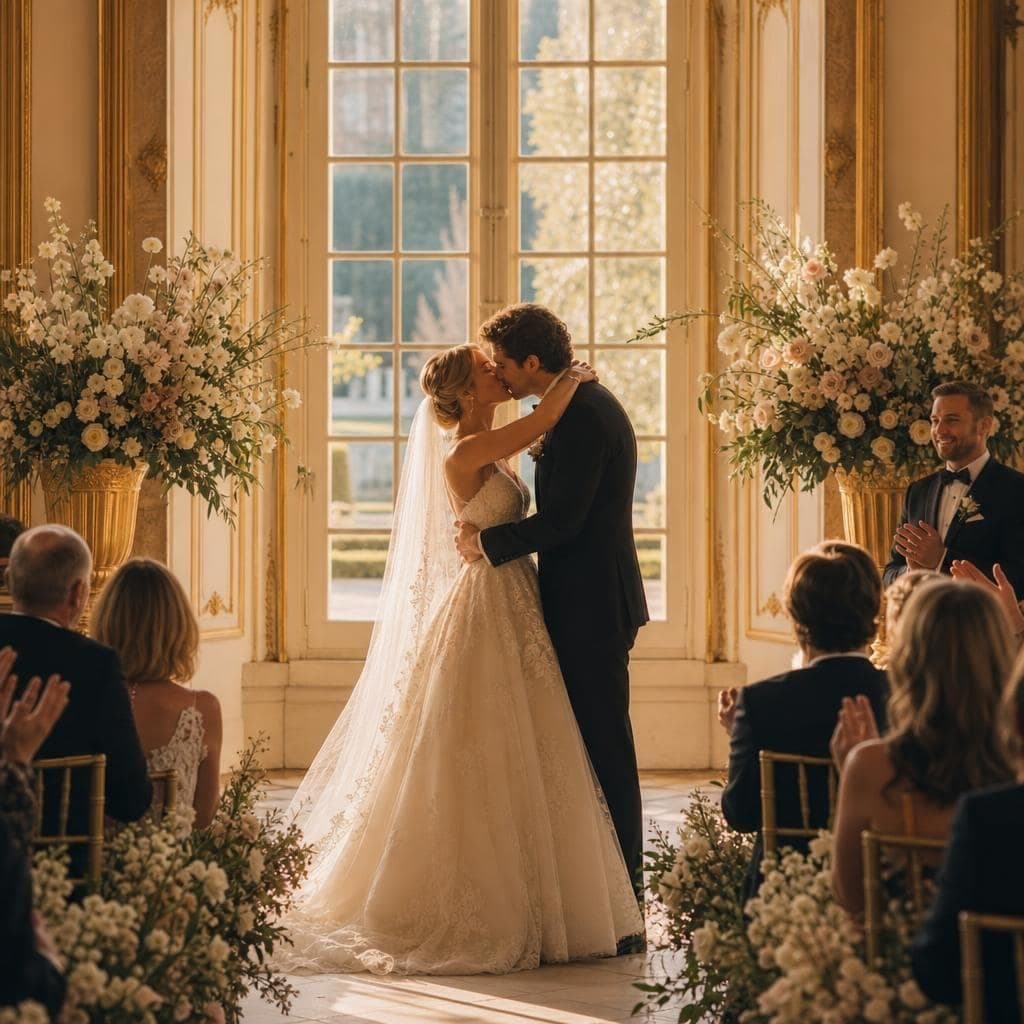
Writing your own vows often impresses more than it reassures when you sit down to do it. The difficulty rarely comes from not having things to say, but from not knowing where to start. A simple structure is enough to unblock the writing.
Clarify the framework before writing
Check what is planned for the ceremony
Depending on the type of ceremony, the space left for personalized vows may vary. Check with the officiant or the person leading the ceremony if a moment is reserved for this, and its approximate duration. Our hour-by-hour reception schedule can help you place this moment in the overall flow of the day.
Agree as a couple on the length
A too large imbalance between two texts, one very short and the other very long, can create unintended awkwardness. Without matching on an identical word count, at least agree on a common order of magnitude.
Find a simple structure
Three parts that almost always work
A memorable moment from the beginning of the relationship, what you admire in the other person today, and what you wish for your life together: this three-part structure gives a guiding thread without locking the text into a rigid format.
Start from anecdotes rather than generalities
A specific memory, even modest, touches more than a general statement about love. Jot down several possible anecdotes before choosing the one that best illustrates what you want to express.
Find the right tone
Stay true to the way you speak
Vows written in a style that is too far from your usual way of speaking can sound false when spoken aloud, even if the text looks beautiful on paper. Read your draft out loud to check that it sounds like you.
Balance humor and emotion
A little humor relaxes the audience and yourself, but a text that is only funny can lack depth. Conversely, a text that is only serious can become hard to sustain emotionally in front of guests. A balance of the two generally works best.
Manage nerves and memorization
Write for speaking, not for silent reading
Short sentences are easier to say than long, complex ones. Read your text out loud several times before the big day to spot passages that lack breath.
Plan a prompt
Even if you know your text well, keeping a card with the main points prevents a memory blank under emotion. No one will hold it against you if you glance at your notes during the ceremony.
Practice without over-rehearsing
Rereading the text several times in the days before helps make it natural, without reciting it word for word: a text that is too memorized can sound less sincere than a text reread with your own spontaneity on the day.
If your ceremony also includes a witness speech, our guide to organize the witness's speech can help you coordinate all the speeches of the day so they don't overlap.
Avoid writing blockages
Start with a list rather than a text
If the blank page blocks you, start by jotting down words, memories, or qualities in no particular order, without trying to construct sentences. The structure will come once the raw material is gathered.
Give yourself several writing sessions
A text written in one go often lacks perspective. Write a first draft, let it rest for a few days, then return to it with a more detached eye to cut what seems superfluous.
Adapt the tone to the type of ceremony
An outdoor secular ceremony does not call for the same register as a more solemn religious ceremony. Match the tone of your vows to the general atmosphere of the ceremony, without renouncing your personal sincerity.
Be inspired without copying
Read examples to find an angle, not a ready-made text
Browsing vow examples can help you understand the general structure or unblock an idea, but a text that is too close to an existing model loses sincerity. Use these examples as a starting point, never as the final text.
Ask for external feedback with caution
A trusted person can proofread your text to check its clarity and length, but keep final control over the content: these are your words, not those of a review committee.
Frequently asked questions
How long should wedding vows last?
Two to three minutes is generally sufficient. A shorter but sincere text is often more striking than a long text that loses the audience's attention.
Should you show your text to your partner before the wedding?
This remains a personal choice. Some couples prefer a complete surprise, others prefer to read together to adjust tone or length. Neither option is better than the other.
What if you have a memory blank during the vows?
Keep a card with the main points of the text within reach. A short silence during which you check your notes usually poses no problem in front of guests.
Can you read your vows rather than recite them?
Yes, absolutely. Reading directly is perfectly acceptable and avoids the stress of complete memorization.
Who writes their vows first, if both do them separately?
The order does not have any particular importance. Some couples prefer to write completely separately until the end, others exchange their first ideas along the way to keep a coherent tone.
Should you keep a written record of your vows after the wedding?
Yes, it is recommended. Keep the final text, possibly framed or included in a memory album: many couples regret not having kept it carefully once the emotion of the day has passed.
What if one of the two doesn't feel comfortable writing?
A text doesn't need to be literary to be sincere. A few simple and honest sentences often touch more than a text that is overworked and loses naturalness.
Can you include a touch of humor in religious or solemn vows?
With moderation, yes. A well-placed light touch rarely harms the solemnity of the moment, as long as it remains coherent with the general tone of the ceremony.
DreamWeds
Find your dream vendors
Photographers, caterers, venues and much more — compare up to 4 vendors side by side.
Discover vendorsArticles on the same topic

Wedding rings: how to choose them?
Material, budget, engraving and order lead times: what to know before buying your wedding rings.
Groom's outfit: how to choose it well?
Tailored or ready-to-wear suit, colors, accessories: the guide to composing a groom's outfit that fits the wedding.
How to choose your wedding dress?
Silhouette, fabric, budget and fitting timelines: the method to find a dress that reflects you without getting lost in the choices.